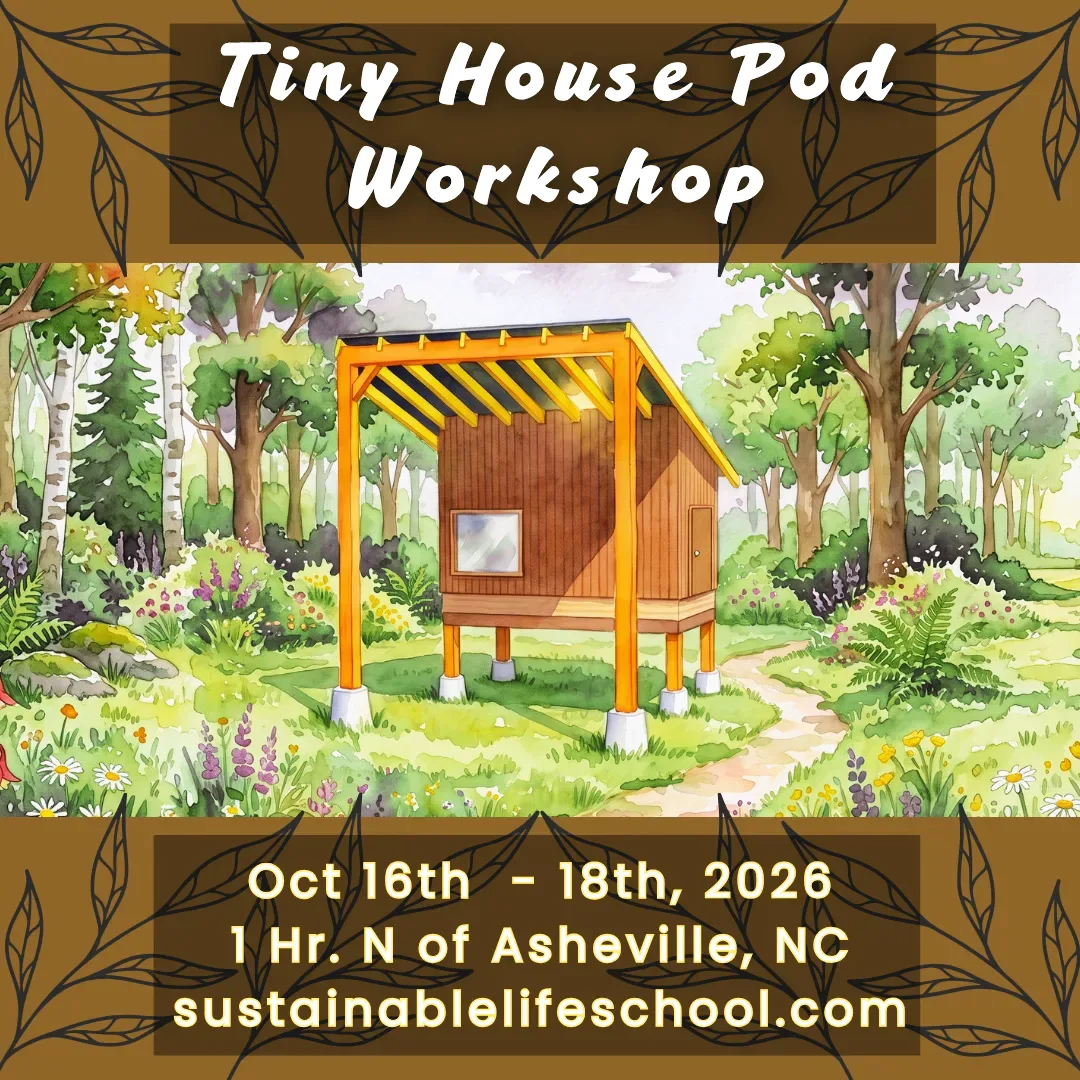
Most building workshops rely on slideshows and mockups. In this intensive 3-day course, you will work alongside designer and natural builder Morgan Caraway and fellow builders to construct an actual Tiny House Pod from the foundation up.
You will gain the physical muscle memory, safety habits, tool proficiency, and technical insight needed to return home and build your own shelter confidently on whatever budget you currently have.
A balanced blend of hands-on building, practical design lectures, off-grid demonstrations, and open Q&A sessions.
We kick off with site layout, ground anchoring without expensive concrete pours, leveling techniques on uneven terrain, and framing the interlocking modular timber skeleton.
Master weather-tight roofing membranes, passive ventilation geometry, airtight vapor barriers, and how gutter-to-cistern plumbing channels can optionally be integrated to harvest rainwater.
Demystifying solar options: understanding how to evaluate your power needs, sizing panels and battery storage, and wiring basics. We cover interior multi-use layouts, emergency shelter conversions, and phased budget planning—explaining how the average cost of a pod stays around 1/14th (about 7%) of a standard tiny house.
Standard tiny homes on wheels or contractor-built shells commonly cost between $60,000 and $100,000+. The Tiny House Pod design is engineered so that the average cost should be around 1/14th (about 7%) of a standard tiny house cost. In the workshop, you will discover the exact timber dimensioning, low-waste framing techniques, and phased installation strategies that deliver high-performance shelter on a fraction of a typical tiny house budget.
Not at all. The workshop is structured for all skill levels. We teach proper tool safety, terminology, and techniques step-by-step. Whether you've never picked up a circular saw or you're an experienced builder wanting to learn off-grid design, you will thrive here.
Bring durable work clothes, sturdy work boots, work gloves, eye and ear protection, a measuring tape, and a notebook. Detailed packing instructions and site directions will be provided upon registration.
The build site is located roughly one hour North of Asheville, NC in a peaceful mountain setting. Camping options are available on-site, and a list of nearby cabin rentals and motels will be shared with registered students.
No, they are completely optional. Many people build a Tiny House Pod as a simple dry cabin, home office, artist studio, or guest bedroom without utilities. Others choose to add modular solar or rainwater collection systems for off-grid living. In the workshop, we show you how both approaches work so you can choose what fits your budget and property.
Yes! If you prefer to have a Tiny House Pod built or pre-fabricated for you, visit our Contact Page to tell us about your project requirements and timeline.